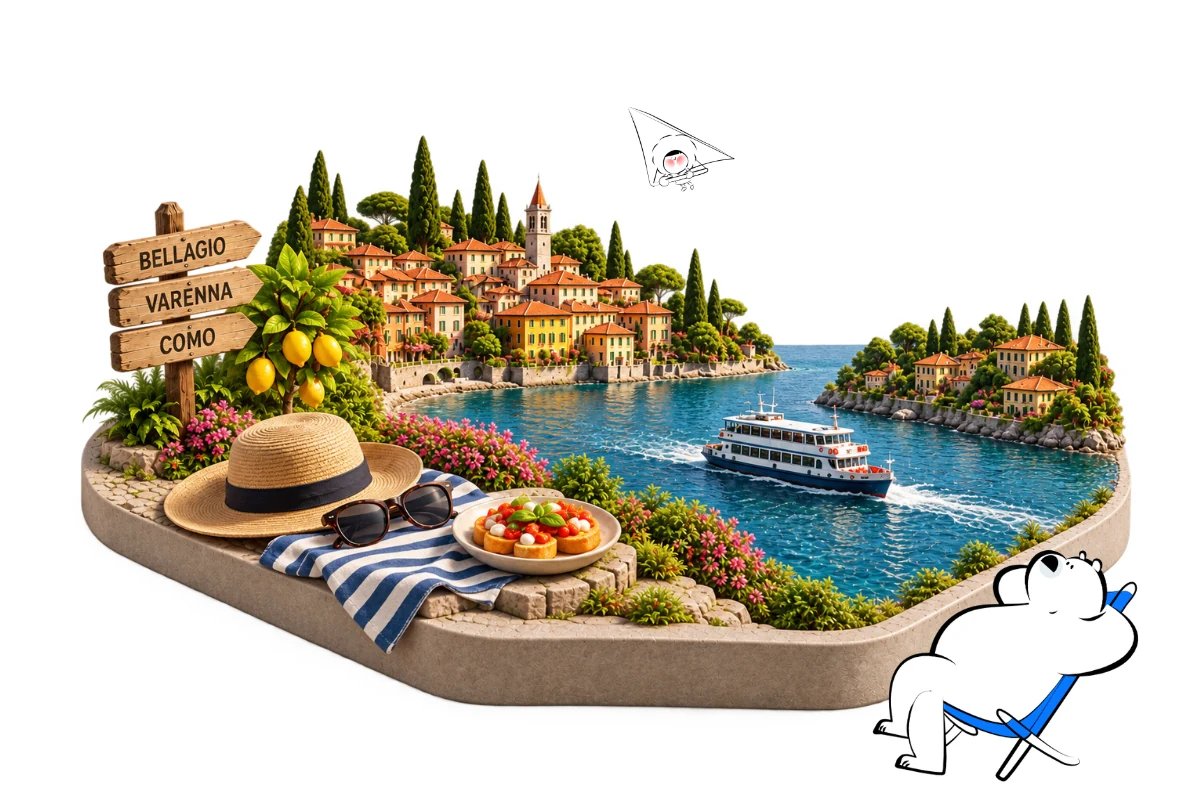
Lake Como is easiest to reach from Milan by train, but the right route depends on which part of the lake you want to visit. Take a direct train to Como for the city and access to the southwestern side of the lake, or travel toward Varenna if Bellagio and the central lake are your priorities.
Once you arrive, the best things to do in Lake Como include riding the ferries, exploring Bellagio and Varenna, visiting historic villas, seeing Como’s old town, taking the funicular to Brunate and walking along the lakeshore.
A day trip from Milan is realistic, but two or three days make it much easier to combine several towns without spending most of your visit racing between boats and stations.
Where Is Lake Como?
Lake Como is in Lombardy in northern Italy, north of Milan and close to the Swiss border. Its distinctive inverted-Y shape means that destinations described simply as “Lake Como” can actually be quite far apart.
Como sits at the southwestern end of the lake. Bellagio occupies the central peninsula where the lake’s branches meet, while Varenna lies across the water on the eastern shore. Menaggio and Tremezzina are on the western side of the central lake.
That geography matters when planning transport. There is no single Lake Como station that works equally well for every destination.
Travelers adding the lake to a longer trip through Rome, Florence, Venice and Milan can also use Eskimo’s 10-day Italy itinerary to place Lake Como within a wider route.
How To Get To Lake Como
For most first-time visitors, train is the simplest way to get to Lake Como from Milan. Driving can make sense for a wider northern Italy road trip, but a car is not necessary for the main towns.
The key is choosing your destination before buying the ticket.
From Milan to Como by train
For Como city, one of the quickest routes runs from Milano Centrale to Como San Giovanni. Trenord currently lists direct trains taking about 40 minutes, with regular departures.
Another useful route runs from Milano Cadorna to Como Lago. The journey takes about an hour, and Como Lago station is particularly convenient for the waterfront and ferry terminal. Trenord lists regular services on this route.
Check the latest departure times and fares through the official Trenord route planner before traveling, especially if you are planning the last connection back to Milan.
From Milan to Varenna
Varenna is often the more practical gateway if your main priorities are Varenna, Bellagio and the central lake.
Travel by train from Milan toward Varenna-Esino, then walk downhill from the station toward Varenna and the ferry landing. From there, ferries connect Varenna with Bellagio and Menaggio.
This route avoids traveling all the way to Como city and then making a long journey north along the lake.
For a simple first-time day trip focused on the central-lake towns, the sequence Milan → Varenna → Bellagio → Varenna → Milan is often easier to manage than trying to combine Como city, Bellagio and Varenna in one rushed day.
From Milan’s airports
Lake Como can also be reached from Milan Malpensa, Linate and Bergamo airports, but the best connection depends on where you plan to stay.
From Malpensa Airport, rail connections can take you toward Milan or other interchange points before you continue to Como. The Malpensa Express also connects the airport with Milano Cadorna, which has direct trains to Como Lago.
From Linate Airport, reaching central Milan first is usually the simplest public-transport strategy before taking a train north.
From Bergamo Airport, expect a longer journey involving bus and rail connections unless you arrange a private transfer or rent a car.
If you land late, check your final train, bus and ferry connections before leaving the airport rather than assuming services run late into the night.
Getting to Lake Como by car
Driving gives you more freedom to reach smaller villages, accommodation away from railway stations and areas with less frequent public transport.
The trade-off is traffic and parking. Roads around the lake can be narrow and busy, particularly during summer weekends and holidays. Parking is also limited around some popular towns and attractions.
Villa del Balbianello, for example, cannot normally be reached directly by visitors’ cars. FAI directs drivers to parking in Lenno, followed by a walk or taxi boat to the property.
For a first visit centered on Como, Varenna and Bellagio, trains and ferries are usually sufficient.
Choosing The Right Lake Como Gateway
Choose Como if you want Como’s historic center, the cathedral, the Brunate funicular and convenient access to the southwestern side of the lake.
Choose Varenna if Bellagio and the central lake are your priorities. Varenna has a railway station and ferry connections, making it particularly useful for visitors arriving from Milan without a car.
Choose Bellagio if you want to stay in one of the lake’s best-known towns. Bellagio does not have its own railway station, so you will normally complete part of the journey by ferry, bus or road.
Choose Menaggio or Tremezzina if your plans focus on the western central shore, Villa Carlotta, Villa del Balbianello or a slower multi-day stay.
Getting Around Lake Como
Ferries are one of the most useful forms of transport around Lake Como and an experience in their own right.
The central-lake network is especially useful for moving among Bellagio, Varenna, Menaggio and Cadenabbia. Other services operate along different sections of the lake, but routes and frequency vary by season.
Navigazione Laghi publishes different Lake Como timetables throughout the year, with services changing seasonally. Check the timetable for your exact travel date rather than relying on an older departure schedule. The operator recommends reaching the ticket office about 20 minutes before departure, with extra time advisable during busy summer and holiday periods.
Use the official Lake Como ferry timetable for current departures and fares. Weather and lake conditions can also affect services, so recheck departures on the day if conditions are poor.
Buses fill some of the gaps along the shore. ASF Autolinee operates routes including Como to Menaggio and Como to Bellagio. Current fares and services can change, so check the official ASF Autolinee information when planning a bus connection.
10 Best Things To Do In Lake Como
1. Take a ferry across the lake
A public ferry is one of the simplest ways to combine transport with lake views.
The central-lake crossings are particularly useful because Bellagio, Varenna and Menaggio sit close enough to combine without committing to a long cruise. From the water, you also get a much clearer sense of the steep shoreline, villas and villages that are difficult to appreciate from the road.
A private boat tour gives you more flexibility and can reach smaller stretches of shoreline, but it costs considerably more than using scheduled public ferries.
2. Explore Bellagio
Bellagio occupies a dramatic position where the lake’s branches meet and remains one of Lake Como’s most visited towns.
Spend time walking the stepped lanes around the historic center, browsing small shops and following the waterfront rather than treating Bellagio as a quick photo stop.
Crowds are usually heavier around the ferry terminal and central streets during the busiest part of the day. An overnight stay or later departure can give you a quieter look at the town after many day visitors have left.
3. Walk through Varenna
Varenna is compact enough to explore on foot and works particularly well for travelers arriving by train.
Walk along the waterfront, explore the lanes climbing away from the lake and follow the lakeside Passeggiata degli Innamorati, or Lovers’ Walk, where accessible.
Varenna also makes logistical sense. You can arrive by rail, spend time in the village, cross to Bellagio by ferry and return to Varenna for your train back toward Milan.
4. Visit Villa del Balbianello
Villa del Balbianello sits on a wooded peninsula at Lenno and is one of Lake Como’s most recognizable historic estates.
The gardens, terraces and lake views are the main draw. Garden-only visits are self-guided, while access to the villa interiors is through a guided visit. Advance booking is mandatory, according to FAI, and opening days vary through the year.
The villa can be reached on foot from Lenno or by paid taxi boat. The standard pedestrian route is roughly 1 km uphill and takes about 25 minutes. It is not suitable for visitors with walking difficulties. FAI provides alternative access arrangements for visitors with reduced mobility, so check the property’s current accessibility information before visiting.
Use the official Villa del Balbianello visitor information for current tickets, opening dates and access rules.
Get Eskimo eSIM to stay connected globally
Need internet while travelling? Here's what we recommend:

Fixed data plans
- No speed reduction
- No expiry, keep your data forever
- Transfer data to anyone
- Personal hotspot


5. See Villa Carlotta or Villa Melzi
If you want another historic garden, choose one that fits your route rather than trying to visit every villa around the lake.
Villa Carlotta in Tremezzina combines a museum with a botanical garden and works well when exploring the western central shore. In 2026, Villa Carlotta’s main daily season runs from March 20 to October 18, followed by reduced autumn opening and selected later dates. Adult admission is currently €17.50.
Check Villa Carlotta’s official visitor information before going, since opening days and hours vary later in the year.
Villa Melzi’s gardens in Bellagio are easier to combine with a day already centered on Bellagio, making them the more convenient choice if you do not plan to cross to Tremezzina.
6. Explore Como’s old town
Como deserves time beyond its railway station and ferry pier.
The historic center is compact and easy to walk, with the Cathedral of Como as its architectural centerpiece. From there, wander through the surrounding streets, squares and waterfront before continuing by ferry or heading to the Brunate funicular.
Como works especially well on an itinerary where the city itself is the destination. If your only priorities are Bellagio and Varenna, arriving through Como can add unnecessary travel time.
7. Ride the Como-Brunate funicular
The funicular climbs from Como to Brunate in about seven minutes and gives you easy access to higher views over the lake and surrounding mountains.
ATM currently lists service from 6 a.m. to midnight, although schedules can change. Accessibility conditions can also depend on the station and facilities in operation, so check current information if step-free access is important for your trip.
Check the official Como-Brunate funicular information before your visit, particularly if you are building the ride around a train or ferry departure.
8. Walk part of the Lake Como Greenway
The Greenway del Lago di Como offers a slower alternative to hopping constantly between towns.
The route follows sections of the western shore through villages, historic sites and lakefront scenery around Tremezzina. You do not need to complete the entire route to enjoy it. A shorter section can fit between villa visits or ferry journeys.
Wear comfortable shoes and check the weather before starting. Summer heat can make exposed walking sections more demanding around midday.
9. Swim at a beach or lido
Swimming is possible around Lake Como, but choose an established beach or lido rather than assuming every stretch of shoreline is suitable.
Access conditions vary, and some shores are steep, rocky, used by boats or difficult to enter safely. Water quality can also vary by location and date.
During summer, established lidos around the lake offer easier access, while public beaches provide another option where conditions permit. Check local signs and official bathing-water information from ATS Insubria before entering the lake. ATS Insubria monitors bathing waters during the season, so current information is more useful than relying on an older assessment of a particular beach.
10. Spend time in Menaggio or Tremezzo
If you have more than a day, add one of the western central-lake towns instead of squeezing another major attraction into an already crowded itinerary.
Menaggio has a waterfront promenade and useful ferry connections across the central lake. Tremezzo and the wider Tremezzina area put you close to Villa Carlotta, Lenno and Villa del Balbianello.
These towns also work well for an overnight base if you want a slower rhythm than a Milan day trip.
Lake Como In One Day Or Two To Three Days
One day is enough for a focused Lake Como trip, but not for the whole lake.
From Milan, a practical day could focus on Varenna and Bellagio. Arrive in Varenna by train, explore the village, cross by ferry to Bellagio, then return to Varenna in time for your train to Milan.
Alternatively, spend the day around Como city, visit the historic center, ride the Brunate funicular and add a short ferry trip.
Trying to combine Como, Varenna, Bellagio, multiple villas and Brunate in one day creates a lot of transit and very little lake time.
With two or three days, you can build a more balanced trip:
- Day 1: Como and Brunate
- Day 2: Varenna, Bellagio and the central-lake ferries
- Day 3: Tremezzina, Villa Carlotta or Villa del Balbianello
For travelers continuing through the country, Eskimo’s Italy public holidays 2026 calendar can help identify national holidays that may affect crowds, opening patterns and transport demand.
Best Time To Visit Lake Como
Late spring and early autumn are strong periods for sightseeing because you can combine outdoor time, ferries, gardens and walking without relying entirely on the hottest part of summer.
May, June and September are particularly practical for travelers who want active days around the lake. July and August bring warm weather and good conditions for swimming, but they also coincide with heavier visitor numbers and greater pressure on accommodation, roads and ferries.
Spring is especially attractive for villa gardens. Autumn brings quieter conditions as the season progresses, but ferry schedules and attraction hours begin to reduce.
Winter is much quieter. Como remains a functioning city throughout the year, but some villas, gardens, boat services and seasonal businesses operate limited schedules or close on selected dates.
Whichever month you choose, check ferry and attraction schedules for your actual travel date rather than assuming summer services operate year-round.
Practical Lake Como Travel Tips
Book high-demand attractions such as Villa del Balbianello ahead, particularly during weekends and the main visitor season.
Leave spare time between ferries and your final train back to Milan. A missed afternoon boat is inconvenient. A missed last practical rail connection is a considerably less charming souvenir.
If you are traveling during an Italian national holiday, check transport and attraction schedules in advance. Popular destinations can also become busier around long weekends.
Comfortable shoes matter. Bellagio, Varenna and many lakeside villages include steps, slopes, cobbles and uneven surfaces.
Keep your daily route geographically sensible. Combining nearby places such as Varenna and Bellagio usually works better than bouncing repeatedly between the northern and southern ends of the lake.
Mobile Data Around Lake Como
Mobile data is useful around Lake Como for checking Trenord departures, live ferry schedules, bus information, walking routes and attraction bookings while moving between towns. Reception is generally stronger in Como and populated lakeside areas, while signal can weaken in tunnels, mountainous terrain and quieter stretches between towns. Coverage depends on terrain and local partner networks.
An Eskimo Italy eSIM plan is the relevant option for a trip focused on Lake Como and Italy. Eskimo’s wider network footprint covers 175 countries and regions overall, which can be useful if Lake Como is part of a longer international itinerary or you have another trip planned later. No-expiry fixed data means eligible unused fixed data can remain available for a future trip instead of needing to be used before leaving Italy.
New users can also claim a free 250MB Global eSIM.
FAQs:
What is the easiest way to get to Lake Como from Milan?
The easiest option for most travelers is the train. Milano Centrale to Como San Giovanni takes about 40 minutes on direct Trenord services, while Milano Cadorna to Como Lago takes about an hour.
Which train station should I use for Lake Como?
Use Como San Giovanni or Como Lago if you want Como city. If your priorities are Varenna, Bellagio and the central lake, traveling toward Varenna-Esino can be more practical, followed by ferry connections.
Can you get to Bellagio by train?
Bellagio does not have a railway station. A common public-transport route is to take the train to Varenna and continue across the lake by ferry. Bellagio can also be reached by bus, road or boat from other parts of Lake Como.
Can you swim in Lake Como?
Yes, swimming is possible at suitable beaches and lidos around Lake Como. Use established access points, follow local signs and check current official bathing-water information from ATS Insubria before swimming because conditions and bathing-water assessments can change.
Is one day enough for Lake Como?
One day is enough for a focused trip such as Varenna and Bellagio or Como and Brunate. Two or three days are better if you also want to visit villas, walk the Greenway and explore both sides of the central lake.